Crushing-Grinding Integration Points: Technical Parameters for Designing a Stone Processing Line
Answer first: when a stone processing line contains both a crushing stage and a grinding stage, the two stages must be specified as one system, and the binding constraint is the transfer point between them. Three parameters decide whether that transfer point works: the maximum particle size the grinding mill will accept at its inlet, the mass flow the mill can absorb per hour, and the moisture content of the material arriving there. A fourth parameter, connected power, decides whether the site can run both stages together. Crusher models, conveyor layout, bin volume and control logic are then selected to satisfy those numbers.
This guide is written for engineers who have to fix the interface between crushing and grinding inside a single production system. It explains the mechanical connection logic, the material flow control and the system balancing that keep a combined line stable, using published parameters from Henan Centbro Machinery (STM) Equipment Co., Ltd — specifically its Stone Crusher Production Line and Stone Crusher and Grinding Production Line modular families.
Problem Definition: The Interface Is a Set of Transferred Quantities
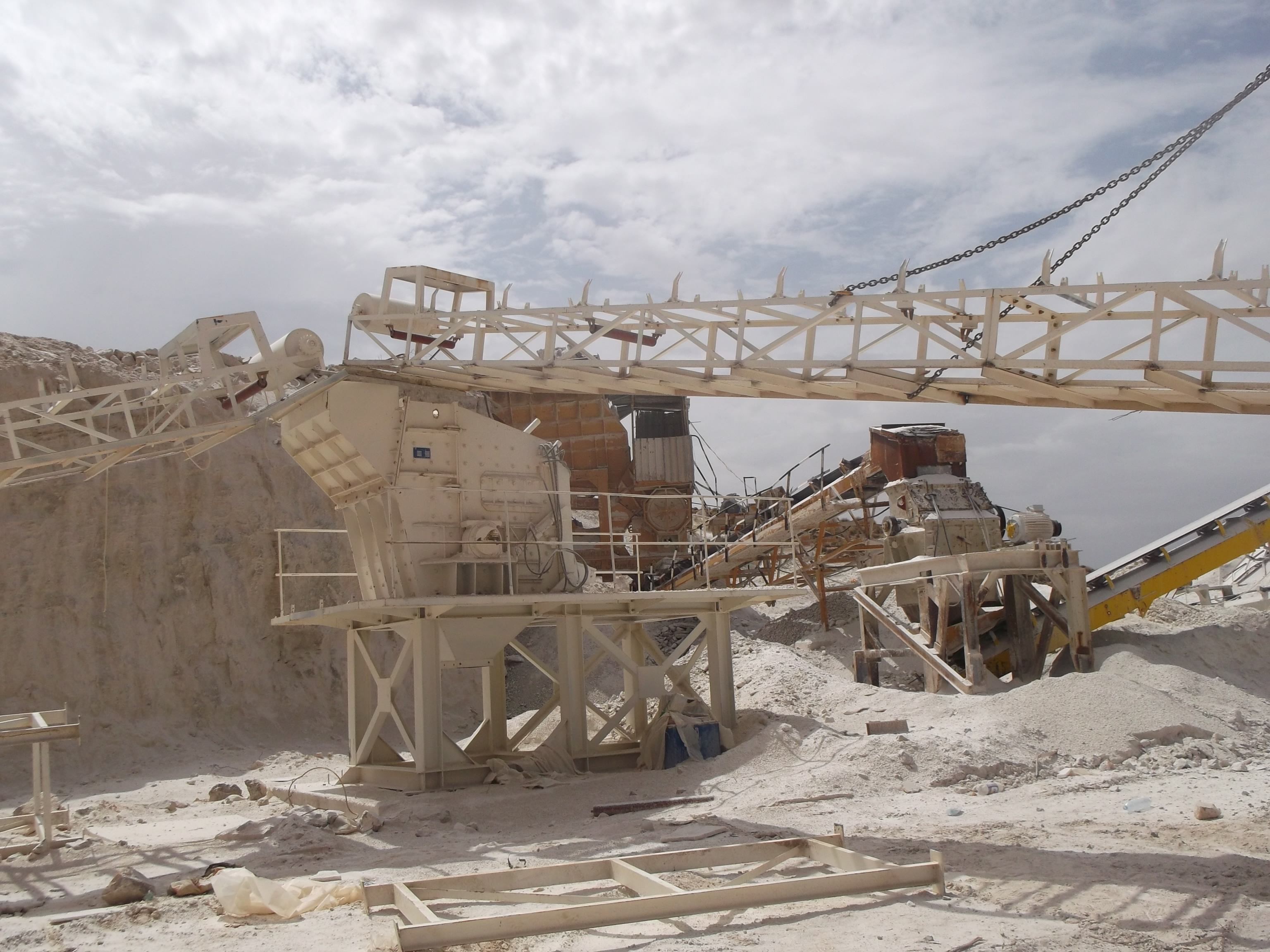
An integration point is where responsibility passes from one machine to another. In a stone processing line it sits between the final crushing unit and the first grinding unit, usually at a discharge chute, a belt conveyor and a feed bin. Four quantities cross that boundary, and each of them behaves differently.
- Particle size. A crushing stage produces a size distribution, while a grinding stage accepts a limit. If the top size of the crusher product exceeds the mill inlet, the mill bridges, stalls or wears abnormally.
- Mass flow. Jaw, impact, cone and VSI crushers are sized for high tonnage; the grinding mill in the same line is usually far smaller in throughput. Without a buffer, the crusher's peak output becomes the mill's problem.
- Moisture. Grinding depends on material that flows freely into the mill inlet and through the classifier circuit. Feed that is wet enough to clump reduces the stability of every downstream process.
- Power. The crushing stage is power-light compared with grinding. Ball mills in the STM catalogue run from 18.5 kW to 800 kW, while the jaw crushers in the same catalogue run from 5.5 kW to 200 kW. The interface therefore also defines an electrical boundary: switchgear, interlocking and start sequence.
Engineers who treat the interface as "a conveyor" tend to discover these constraints only after the mill has been ordered. Writing them into the design as parameters with tolerances keeps the two stages in balance.
Industry Background: Why Crushers and Mills Are Now Specified Together
The crusher market is large enough, and fragmented enough, for a combined crusher-and-grinding configuration to be a normal request rather than an exception. Market Research Future estimated the global crusher market at USD 6,751.19 million in 2024 and projected USD 12,710.1 million by 2035, while Zion Market Research valued stone crushing equipment at approximately USD 5.06 billion in 2024. Within that market, Fact.MR estimates that jaw crushers account for approximately 46% of the crushing equipment product segment by 2026 — a figure worth remembering, because the jaw crusher is normally the first machine in an integrated line and almost never the last. Asia Pacific is the largest and fastest-growing region, with China's crusher market estimated at USD 827.02 million in 2024, and the global mobile crusher and screener market was valued at USD 4.59 billion in 2024 with a projected CAGR of 7.32% through 2035.
Two practical consequences follow. First, product requirements are tightening: aggregate producers increasingly need manufactured sand and filler powder from the same deposit, which pushes a grinding stage into lines that previously stopped at tertiary crushing. Second, buyers now compare suppliers on their ability to specify both stages together. Metso Outotec, Sandvik and Terex Corporation are identified as the leading global manufacturers, together holding approximately 30–35% of the jaw crusher market share; the remainder of the market is served by regional manufacturers who typically compete on configuration flexibility rather than catalogue breadth.
Henan Centbro Machinery (STM) Equipment Co., Ltd is one of those configuration-focused manufacturers. Founded in 1982 and located in the Zhengzhou National High-tech Development Zone on an 8,000 m² site, the company integrates R&D, production and sales, employs more than 50 people and maintains an R&D team of 20 engineers. It publishes two relevant modular families: the Stone Crusher Production Line, configured with PE-Jaw Crusher, Impact Crusher, Cone Crusher or VSI Sand Making Machine modules, and the Stone Crusher and Grinding Production Line, configured with ball mills, YGM high-pressure mills and MTW mills. Export business accounts for 100% of sales, with products continuously shipped to Russia, Kazakhstan, the Philippines, the Middle East, South America, Africa and other regions.
Detailed Solution: The Parameters That Define the Crushing–Grinding Interface
1. Inlet-size window: work backwards from the mill
The first parameter to fix is the maximum feed size of the grinding mill, because it is the least flexible number in the line. In the STM grinding line, the YGM high-pressure mill family accepts 15 mm at model YGM75, 25 mm at YGM95, 30 mm at YGM130, 35 mm at YGM160 and 40 mm at YGM190, while the MTW family accepts 30 mm at MTW110, 35 mm at MTW138 and 40 mm at MTW175. Finished fineness is adjustable between 0.613 mm and 0.033 mm for the YGM series, and between 1.6 mm and 0.038 mm for the MTW series.
Those inlet values dictate the final crushing stage. A tertiary cone crusher or a VSI is normally used, because both can be closed down to a controlled top size. The STM VSI Impact Sand Making Stone Crusher Machine accepts material below 30 mm at VSI7611, below 35 mm at VSI8518, below 40 mm at VSI9526 and below 45 mm at VSI1140 — size windows that sit directly in front of the MTW and YGM inlet limits. Where a cone is preferred, comparable options include the Spring Cone Crusher PYD600 with a 40 mm feed opening and 12–23 t/h output, the CS Symons Cone Crusher CSC-160 with a 200 mm feed opening and 135–350 t/h output, or the Multi Cylinder Hydraulic Stone Cone Crusher HPT-300F with a 105 mm feed opening and 110–260 t/h output.
The design rule is straightforward: the closed-side setting of the final crusher is fixed by the mill inlet, not by the aggregate specification alone. Where an aggregate product must also meet a commercial grade, the two requirements are reconciled by placing a screen between the crushing and grinding stages so that only the undersize fraction reports to the mill.
2. Mass-flow balancing: size the buffer, not the mill
Capacity is the second interface parameter and the most commonly mismatched one. Crusher throughput in the STM catalogue spans 1–90 t/h for the PE-Jaw Crusher, 15–350 t/h for the Impact Crusher, 120–855 t/h for the cone module and 60–520 t/h for the VSI sand making module. Grinding throughput is an order of magnitude smaller: 0.65–2 t/h at ball mill B900*1800, rising to 20–150 t/h at B3200*4500; 1–3 t/h at YGM75, rising to 9–27 t/h at YGM190; and 3.5–10 t/h at MTW110, 6.5–15 t/h at MTW138 and 11–25 t/h at MTW175.
A line in which the crusher discharges 200 t/h and the mill consumes 20 t/h is not a mistake, but it cannot be run as a single continuous stream. It needs a buffer: a feed bin between the two stages, sized to the shift pattern, with a controlled feeder at the mill inlet. That arrangement converts an unbalanced instantaneous match into a balanced daily one — the crushing stage runs intermittently, the grinding stage runs continuously.
3. Moisture: the drying sub-stage as an interface element
Moisture is the parameter that most often forces a change in line architecture. Where quarried feed or manufactured sand carries free water, a drying unit is inserted between crushing and grinding. The STM Crusher Stone Drying Production Line covers rotary dryers from model 600*6000 at 3 kW and 0.5–1.5 t/h output up to model 4.2*8m at 22×4 kW and 70–120 t/h, with intermediate models such as 1200*10000 at 7.5 kW and 1000*10000 at 5.5 kW for smaller lines.
An OEM installation in Kazakhstan shows what the drying interface is expected to deliver. The line was configured to dry manufactured sand, pebbles, quartz sand and ore powder, reducing moisture content to serve mixing plants, construction projects, packaging and transport. The reported project benefits included reduced material clumping and blockage, improved stability of subsequent processes, and lower transportation costs, with the drying degree adjustable to the requirement.
For the interface specification, the useful numbers are the dryer throughput relative to the mill throughput and the dryer outlet moisture target. Both should be written as line parameters, because a dryer sized only against the crusher will either starve or flood the mill.
4. Mechanical connection: transfer points and dust sealing
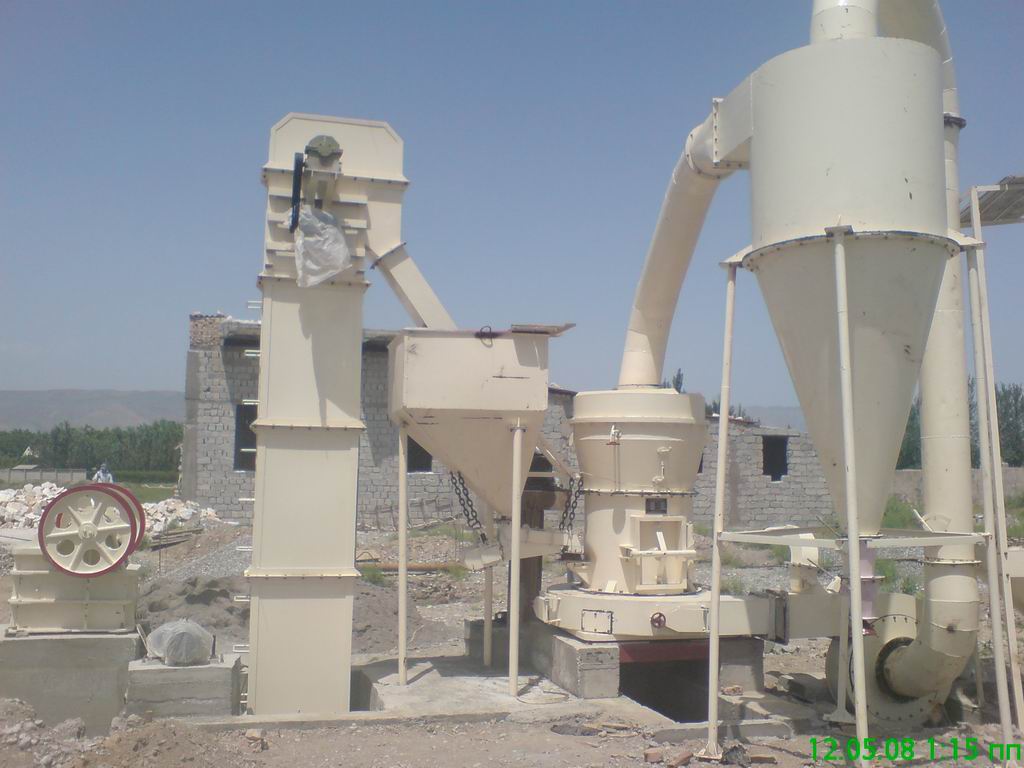
Mechanically, the interface consists of a discharge chute, a Belt Conveyor, an optional screen, a surge bin, a Vibrating Feeder and the mill inlet. All of these appear in the STM main product list, which is why they can be specified as one package rather than assembled from separate suppliers.
Design attention belongs in three places: chute geometry, so that material does not free-fall onto the mill inlet; the bin, which absorbs crusher surges; and sealing at each transfer point. Dust generated at the crusher discharge can be finer than the classifier product in some circuits, so sealing and dust collection at the interface also protect the finished powder specification.
5. Power and drive: define the electrical boundary
Connected load is an interface parameter because it determines the transformer and switchgear specification. In the STM range, the PE-Jaw Crusher module runs from 5.5 kW to 75 kW, the European Jaw Crusher from 30 kW to 200 kW, the Impact Crusher from 37 kW to 375 kW, the cone modules from 160 kW to 400 kW and the VSI modules from 110 kW to 400 kW. On the grinding side, ball mills run from 18.5 kW to 800 kW and the YGM mills from 18.5 kW to 250 kW. The practical implication is that the grinding stage usually dominates connected load, so the mill's starting method and the interlocking order should be agreed before the crusher configuration is finalised.
6. Control logic and interlocking
The interface is also a control boundary. A workable sequence starts mill lubrication and the discharge conveyor first, then the mill, then the feed conveyor and bin discharge, and brings the crushing stage online last. Level indication in the surge bin, a belt scale on the feed conveyor and temperature monitoring on mill bearings provide the three signals an operator needs to hold the line in balance. If any of them drifts, the correct action is to stop feed to the mill, not to stop the mill itself.
7. Maintenance access as a design parameter
Grinding mill liners and grinding rollers wear faster per tonne than crusher jaws. If the mill is placed directly downstream of the crusher without clearance, a liner change becomes a plant shutdown instead of a scheduled task. Access space is therefore a parameter of the interface layout, not an afterthought for the site plan.
Step-by-Step Breakdown: Designing the Integration Point
- Fix the finished product specification. Define top size, fineness target and moisture target for the material leaving the line. For powder products, the STM grinding line covers 0.613–0.033 mm with YGM mills, 1.6–0.038 mm with MTW mills, and 0.075–0.89 mm down to 0.074–0.4 mm with ball mills depending on model.
- Select the grinding stage from that specification. Choose between ball mill, YGM high-pressure mill and MTW mill, then confirm the model's capacity band: 0.65–150 t/h for ball mills, 1–27 t/h for YGM mills, 3.5–25 t/h for MTW mills.
- Read the mill's inlet limit and set the crusher target from it. 15–40 mm across the YGM and MTW families; finer for ball mill circuits.
- Choose the crushing stages. A primary jaw or European jaw crusher for run-of-mine size, a secondary impact or cone for reduction, and a tertiary cone or VSI to land inside the mill inlet window — for example VSI7611 below 30 mm, VSI9526 below 40 mm, or a CS Symons cone with a 200 mm feed opening.
- Reconcile capacity. Compare crusher tons per hour against mill tons per hour, then insert a surge bin and feeder and define the operating shift pattern. Do not attempt to match them instantaneously.
- Decide whether drying is required. If feed moisture is high, insert a Crusher Stone Drying Production Line unit, select the model by throughput, and write the outlet moisture target into the line specification.
- Set the electrical and control boundary. Total the connected load for both stages, define the start sequence and interlocking, and confirm the site's supply capacity before ordering.
- Validate and commission. Confirm factory testing of each unit, then plan site installation and commissioning, including the interface conveyors and the bin, as a single scope.
Use Cases: How the Interface Is Specified in Practice
Case 1 — Coarse-crushing interface for a sand and gravel line (Mongolia)
An OEM customer in Mongolia uses jaw crushers as the core front-end equipment of sand and gravel production lines, with 5 units in service for 10 years. The stated purpose is coarse crushing in mining: processing raw rock from mountains and rivers to provide qualified feed for the cone crushers and sand making machines downstream. Reported benefits are uniform, stable coarse crushed stone, lower wear on downstream equipment and a reduced risk of material blockage. This is the classic interface case — the jaw crusher's job is not to make a finished product but to make feed the next stage can accept.
Case 2 — Aggregate line with high output and environmental requirements (Russia)
A Russian project involving 10 units was configured for concrete aggregate for infrastructure, water conservancy and real estate applications and has been operated for 10 years. The reported results include output that met the operator's expectations, finished material meeting industry requirements, and a production process consistent with national environmental requirements. In lines of this type, the key interface decision is whether to close the circuit at tertiary crushing or to add a grinding stage; that decision is usually driven by the share of the deposit that would otherwise be lost as waste.
Case 3 — Fine and ultrafine powder stage (Algeria)
A 5-unit OEM installation in Algeria grinds limestone, calcite, dolomite, barite, talc, quartz, feldspar, coal gangue and slag into fine and ultrafine powders for building materials, chemicals, metallurgy, environmental protection and infrastructure. The reported capability is adjustable fineness, generally between 80 and 2500 mesh, with a classifier producing a concentrated particle size distribution and fewer impurities. For the interface, the relevant point is that the feed presented to this stage must already sit inside the mill inlet limits — which is precisely what the upstream crushing stage is configured to produce.
Case 4 — Drying interface ahead of powder processing (Kazakhstan)
The Kazakhstan drying line, installed as 2 units and in operation for 10 years, dries manufactured sand, pebbles, quartz sand and ore powder for mixing plants, construction projects, packaging and transport. Reported project benefits are less clumping and blockage, more stable subsequent processes and lower transport costs. Where such a line feeds a mill, the dryer's outlet moisture becomes an interface parameter in its own right and should be specified together with the mill inlet size.
Comparison Table: Crusher-Only Line vs. Crusher-and-Grinding Line
| Design parameter | Stone Crusher Production Line | Stone Crusher and Grinding Production Line |
|---|---|---|
| Primary function | Size reduction to aggregate and manufactured sand grades | Size reduction followed by fine / ultrafine grinding to powder |
| Published modules | PE-Jaw Crusher, Impact Crusher, Cone Crusher, VSI Sand Making Machine | Ball mill B900*1800 – B3200*4500, YGM75 – YGM190, MTW110 – MTW175 |
| Stage power range | 5.5–400 kW (PE-Jaw 5.5–75 kW; European Jaw 30–200 kW; Impact 37–375 kW; Cone 160–400 kW; VSI 110–400 kW) | Ball mill 18.5–800 kW; YGM mill 18.5–250 kW |
| Stage capacity range | Jaw 1–90 t/h; Impact 15–350 t/h; Cone 120–855 t/h; VSI 60–520 t/h | Ball mill 0.65–150 t/h; YGM 1–27 t/h; MTW 3.5–25 t/h |
| Feed window of the final stage | Feed openings from 250–125 mm (PE-Jaw Crusher) up to 1400×1200 mm (Crawler Mobile Crusher SY-C150) | Mill inlet 15–40 mm (YGM and MTW families) |
| Finished product range | Aggregate sizes set by screen aperture and closed-side setting | 0.613–0.033 mm (YGM); 1.6–0.038 mm (MTW); 0.075–0.89 mm to 0.074–0.4 mm (ball mill, by model) |
| Critical interface parameter | Discharge setting and screen cut of the final crusher | Inlet top size and feed moisture at the mill |
| Typical reason to select | Market requires aggregate and sand only | Deposit or market requires powder, filler or high-fines manufactured sand |
| Interface hardware typically required | Screens, Belt Conveyor, stockpiles | Screen, surge bin, Vibrating Feeder, belt scale, dust sealing, often a rotary dryer |
FAQ
Does an integrated crushing and grinding line fall under a specific standard?
For mobile units, ISO 21873-2:2019 specifies safety requirements and verification for mobile crushers used in rock crushing and construction recycling. For stationary lines, the supplier's quality management system is the reference point: Henan Centbro Machinery (STM) Equipment Co., Ltd states that it took the lead in passing the ISO9001:2008 international quality management system certification and holds a European Union CE certificate. Its product patent issued by CNIPA (No. 14247490, issued 24 September 2021, valid to 25 December 2030) lists the European Jaw Crusher, Impact crusher, Spring Cone Crusher, CS Symons Cone Crusher, Multi Cylinder Hydraulic Stone Cone Crusher, VSI Impact Sand Making Stone Crusher Machine and both production line families among its related products.
Can one supplier deliver both the crushing stage and the grinding stage?
Yes, if the supplier's catalogue covers both stages as modular families. STM publishes the Stone Crusher Production Line — configured with PE-Jaw Crusher, Impact Crusher, Cone Crusher or VSI Sand Making Machine — alongside the Stone Crusher and Grinding Production Line, which includes ball mills from B900*1800 to B3200*4500, YGM mills from YGM75 to YGM190 and MTW mills from MTW110 to MTW175. Because both families come from the same design office, the crusher discharge setting and the mill inlet limit can be reconciled at the specification stage rather than at commissioning.
What drives the budget of the crushing–grinding interface?
The interface cost is a function of configuration, not of a single machine. The main drivers are the number of crushing stages needed to reach the mill inlet window, the mill family and its connected load (a ball mill can reach 800 kW while a YGM mill reaches 250 kW), whether a drying unit is required and its throughput class, the size of the surge bin and feeder, the extent of dust sealing, and the electrical infrastructure needed for the combined load. Because these variables differ from project to project, quotations are issued against a defined configuration and feed material rather than as a catalogue price.
How is the interface validated before shipment and on site?
STM applies 100% testing as its stated quality control standard, and offers OEM production with customization of voltage and logo. After purchase, the company assigns after-sales service engineers to the site for installation and commissioning until the customer can operate the machine, with support delivered first through online guidance and then through offline engineer guidance and collaboration on site. The minimum order quantity for this programme is 2 units.
What is the lead time for a coordinated line, and what is the next step?
The standard lead time is 30 days, with a monthly capacity of 8,000 units and a minimum order quantity of 2 units. To move from parameters to a quotation, send the feed material description, the required finished fineness and moisture target, and the target hourly output; the interface configuration can then be fixed together with the crushing stages that feed it. The full STM product brochure lists the models referenced above, and the engineering team can be reached at Kevin@centbro.com, by phone or WhatsApp on +86 187-3712-0960.
Conclusion: Fix the Transfer Point Before You Fix the Machines
A stone processing line that combines crushing and grinding is not two plants placed next to each other. It is one system whose stability depends on four numbers crossing a single boundary: the mill inlet size, the mass flow, the feed moisture and the connected power. The engineering order of operations follows from that. Fix the finished product specification, select the grinding stage, read its inlet limit, then configure crushing until the discharge lands inside that window — and only then balance capacity, moisture and power. Where the two stages cannot be matched instantly, insert a bin, a feeder and, if necessary, a dryer, so that the line runs as a balanced daily process rather than a permanently unbalanced instantaneous one.
Specifying a combined crushing and grinding line?
Share your feed material, target fineness and hourly output with the STM engineering team and the interface parameters — inlet size, buffer volume, moisture target and connected load — can be fixed together with the crusher and mill configuration.
Download the STM product brochure · centbrocrusher.com · Email: Kevin@centbro.com · Tel / WhatsApp: +86 187-3712-0960
Address: High-tech Development Zone, Zhengzhou City, Henan, China
Have Questions or Need More Details?
Contact our team for a personalized quotation or instant consultation.
Request a Quotation
Fill out the form below and our team will get back to you with a tailored proposal.
WhatsApp Direct Chat
Prefer to chat in real-time? Message us on WhatsApp for instant assistance & quick answers.
- Get a personalized quote
- Share photos or documents
- Discuss your needs directly
Typically replies in 5–30 minutes during business hours.