Crusher Application FAQ: Matching Portable, Grinding & Drying Units
Crusher Application FAQ: Matching Portable, Grinding & Drying Units
Matching a crusher line to a project site comes down to three variables: how often the plant has to relocate, what condition the feed arrives in, and where the process actually stops — at sized aggregate, at milled powder, or at dry powder that is ready to be milled. Everything else, including model numbers, follows from those three answers.

A crawler mobile crusher is one of the two portable formats used when the plant has to follow the deposit rather than the other way around.
This FAQ collects the questions buyers raise most often when they compare a Stone Crusher Production Line, a Portable Stone Crusher, a Stone Crusher and Grinding Production Line, and a Crusher Stone Drying Production Line. The answers are written around deployment fit — site mobility, feed condition and processing sequence — rather than around a ranked product list, because a line that suits a long-term quarry is rarely the line that suits a road project that moves four times a year.
What actually decides the line type?
Three site characteristics separate the four configurations before any equipment discussion starts.
- Mobility. Does the plant stay in one place for the life of the reserve, or does it need to be moved between borrow areas, road sections or satellite pits?
- Feed condition. Is the run-of-mine material dry and free-flowing, or does it arrive wet, sticky or mixed with clay, so that handling and drying become part of the process?
- Process end point. Does the project sell sized aggregate, does it need manufactured sand, or does it need fine powder that has to be milled?
Secondary questions — compliance, lead time, service coverage — matter, but they do not change the line type. They change the supplier conversation once the type is fixed.
The four line types in short
A Stone Crusher Production Line is the fixed, staged arrangement that takes run-of-mine rock down through coarse, medium and fine reduction, then screens it into finished sizes. In the sand-and-gravel projects STM documents, the typical flow runs raw material bin → feeder → jaw crusher (coarse) → cone crusher (medium and fine) → vibrating screen → return crusher → VSI sand making machine → finished product screen → finished product silo, with unqualified material recirculated and PLC-linked start and stop across the whole line.
A Portable Stone Crusher puts the crushing and screening function on a chassis so the plant can be relocated. STM builds this format in two families — tyre type mobile crushers and crawler mobile crushers — and mounts jaw, impact, cone, VSI and hammer units on them depending on the duty.
A Stone Crusher and Grinding Production Line continues past aggregate into milling. Size reduction is only the front half: the configuration adds grinding equipment where the product specification is a powder rather than a sized stone.
A Crusher Stone Drying Production Line is a moisture-control stage. It does not replace crushing or grinding; it conditions the material so that the downstream stage can work on it.
Why the sequence matters more than the equipment list
The same set of crushers can be arranged into a good line or a bad one, and the difference is visible in the flow rather than in the specification sheet. Two patterns recur across the application records STM publishes.
The first is stepwise size reduction with closed-loop recirculation. Material moves from coarse to medium to fine reduction and then to sand making, and oversize from the screens is returned to a return crusher rather than being discarded. The engineering project record for Kenya describes exactly this: particle size is reduced step by step through coarse crushing, medium crushing, fine crushing and sand making, with closed-loop circulation of substandard material and centralised PLC control over the whole line.
The second is conditioning before the final stage. Where the material must be milled, the process record for a crusher stone line states that the powder needs to be cleaned and dried before it is ground, using high-pressure grinding equipment or a ball mill. That single sentence is why drying is a sequence decision and not an accessory: it sits between crushing and grinding, and it only earns its place when the material and the product specification call for it.
Question 1: When is a Stone Crusher Production Line the right base configuration?
A fixed Stone Crusher Production Line is the better fit whenever the site is stable for years and the plant layout can be built once. It allows the full sequence — feeder, primary crusher, secondary crusher, screens, return crusher, sand making machine and finished product silos — to be laid out for material flow, and it allows support systems to be designed in rather than bolted on.
That integration is the real argument for the fixed format. In the infrastructure record for Georgia, the line for highway, expressway and railway subgrade filling, airport and port construction, water conservancy works and urban municipal roads includes a bag filter dust collector, spray dust suppression, soundproof covers and sealed belt covers as part of the plant, with wheel or spiral sand washing added where specification demands it. Those systems need fixed positions and fixed ducting. On a plant that relocates every season, they are the first thing to be dropped.
The fixed line also handles the recirculation loop well. Material rejected by the finished product screen has a short, predictable path back to the return crusher, which is what keeps the closed loop efficient in the sand-and-gravel flow.
Question 2: When does a Portable Stone Crusher replace a fixed line?
A Portable Stone Crusher replaces the fixed line when the material moves and the plant has to move with it — satellite pits, borrow areas along a road alignment, tunnel portals, or demolition and construction waste streams that are generated in different places. In those cases the cost of building and dismantling a fixed layout each time outweighs any layout advantage.

A tyre type mobile impact crusher: the portable format for projects where the pit changes more often than the product does.
The trade-off is that the portable format compresses the flowsheet onto a chassis. A single mobile unit typically carries one crushing stage plus a screen, so a multi-stage duty becomes a train of units rather than one integrated plant. That is a deployment fact, not a limitation of any particular model, and it is the reason portable plants are usually specified against a defined relocation cycle and a defined product mix.
The portable families STM lists cover a wide duty range. The tyre type mobile impact crusher Y3S1548F1010 is listed at 70–90 kW with 30–275 t/h output, while the crawler mobile crusher SY-C120 lists a 1200×870 mm feed opening and 175–540 t/h. Those two examples are enough to show that \"portable\" does not mean small — but the figures belong to specific configurations, so they should be checked against the actual unit being quoted rather than treated as a category range.
Question 3: Tyre type or crawler mobile crusher — what should a site check?
The choice between tyre type and crawler comes down to how the unit travels and how often.
Tyre type mobile crushers are towed between locations and are the natural fit where relocations are planned, infrequent, and served by an existing haul road or public road network. Crawler mobile crushers move on their own tracks, which suits working faces where the plant has to advance with the excavation and where the ground is uneven. The crawler model SY-C120, with its 1200×870 mm feed opening and 175–540 t/h listed output, is sized for production duties rather than for intermittent work.
Three checks settle the decision in practice. First, the haul road: a towed unit needs a route it can actually travel. Second, the relocation frequency: a unit that moves weekly behaves differently from one that moves once per contract. Third, the feed size against the feed opening — a large feed opening reduces the need for primary breaking before the plant, which changes the whole fleet requirement.
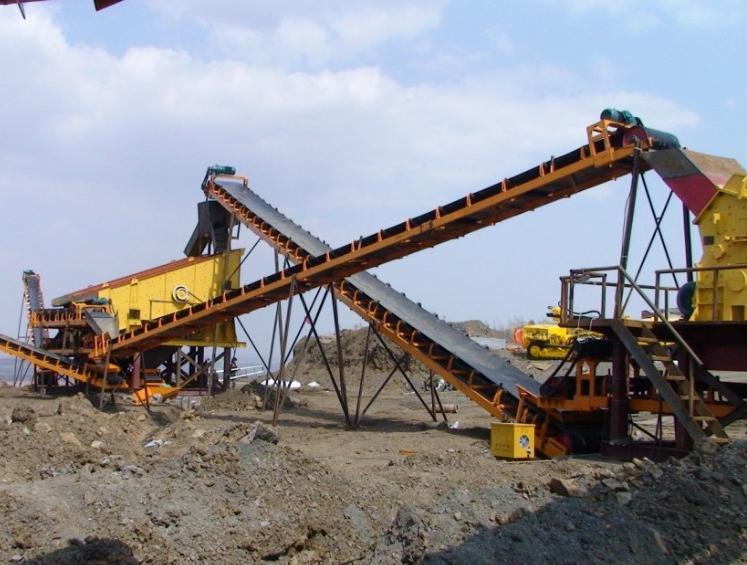
Raw stone crushing: the feed condition at the face decides how much of the flowsheet has to be designed around handling rather than reduction.
Question 4: When does a project need a Stone Crusher and Grinding Production Line?
The grinding line becomes necessary when the product specification ends below crushed aggregate — when the customer needs milled powder rather than sized stone. Crushing and screening can produce aggregate and manufactured sand; they cannot produce a milled product. Once the specification is a powder fineness, the flowsheet has to add milling equipment, and the line changes character.
STM lists the B2700*4500 configuration of the Stone Crusher and Grinding Production Line at 430 kW with 12–90 t/h output. That figure is worth reading carefully against the crusher figures quoted earlier in this article, because the magnitudes are different: a grinding line's throughput is measured in the tens of tonnes per hour while a production crusher is measured in the hundreds. Grinding is therefore a separate capacity decision, not an extension of the crushing capacity.
The practical consequence for a project site is that the grinding circuit should be sized from the product demand backwards, with the crushing circuit sized to feed it — not the other way round.
Question 5: When is a Crusher Stone Drying Production Line justified?
Drying is justified when moisture, not size, is the constraint. The process record for the crusher stone line puts it plainly: where grinding is required, the powder needs to be cleaned and dried before it is ground. A Crusher Stone Drying Production Line exists to make that conditioning step a controlled part of the flowsheet instead of an improvised one.

A drying unit sits between crushing and grinding, and only earns its place when moisture is the actual constraint.
The 2.2*5 m drying unit is listed at 7.5×2 kW with 15–23 t/h output. Because that figure is far below the listed output of the crushers discussed above, a line that includes drying will normally be paced by the drying stage unless drying capacity is scaled up or the dried stream is only a fraction of total output. That is a sizing question to settle at configuration stage, not after commissioning.
Two conditions argue against adding drying. If the feed is already dry and the product stops at aggregate, drying adds a stage with no process reason behind it. If the moisture varies seasonally, the drying unit has to be specified for the wet season rather than the annual average.
Question 6: Which crusher types belong in which sequence position?
Position in the flowsheet, not brand preference, determines the crusher type.
- Coarse crushing. Jaw crushers, including the European Jaw Crusher range from PEW180*1300 through PEW1100*1200, take the run-of-mine feed. The same duty appears with impact or cone crushers in the mining record, where primary crushing uses jaw, impact or cone depending on the ore.
- Medium and fine crushing. Cone crushers carry this stage in the sand-and-gravel and infrastructure flows. STM lists spring cone crushers (PYB/PYZ/PYD series), CS Symons cone crushers such as CSC-75 at 75 kW and 59–163 t/h and CSC-130 at 132 kW and 105–220 t/h, and multi-cylinder hydraulic cone crushers in the HPT series. Where high throughput is the constraint, the single-cylinder CH660 is listed at 315 kW with a 65–275 mm feed opening and 190–665 t/h.
- Sand making and shaping. VSI impact sand making machines (VSI7611, VSI8518, VSI9526, VSI1140) close the size-reduction chain in the standard flow. In the mining record the material can also pass to a hammer crusher after primary crushing; STM lists hammer crushers from 400*400 at 7.5 kW and 5–8 t/h up to 1250*800 at 132 kW and 20–50 t/h.
- Grinding. Ball mill and high-pressure grinding equipment follow drying where a milled product is required.
How three real site profiles map onto the four line types
The documented application records fall into three recognisable profiles, and each profile points to a different default.
Profile A — long-term aggregate supply for construction projects
A supplier producing sand and gravel for highway, railway, bridge, tunnel, water conservancy and real estate projects runs a staged fixed line: jaw for coarse reduction, cone for medium and fine reduction, vibrating screen, return crusher, VSI sand making machine, finished product screen and finished product silo. Production is continuous and automated, with closed-loop recirculation and PLC control. This is the case where a Stone Crusher Production Line is the natural base, and the portable question does not really arise unless a second, temporary supply point appears.
Profile B — infrastructure subgrade and structural fill
Highway, expressway and railway subgrade filling, airport and port work, dams and reservoirs, and urban subway or municipal road construction use the same reduction logic with a heavier emphasis on screening, grading and environmental control. The Georgia record adds dust collection, spray suppression, soundproofing and sealed belts to the flowsheet, plus washing where the specification requires it. Here the line is fixed and the environmental systems are part of the design.
Profile C — mining and mineral preparation
Where raw ore is reduced to prepare feed for mineral processing and sand making, the record shows jaw, impact and VSI equipment with belt conveyors, and it introduces the downstream branch: if grinding is required, the powder is cleaned and dried before high-pressure grinding equipment or a ball mill. This is the profile that turns a crushing question into a crushing-plus-grinding-plus-drying question.
Comparison: the four line types on the same dimensions
| Line type | Site fit | Process role | Listed example configuration |
|---|---|---|---|
| Stone Crusher Production Line | Stable, long-term site with room for a fixed layout and support systems | Full staged reduction and screening with closed-loop recirculation and PLC-linked control | Line assembled from jaw, cone, vibrating screen, return crusher, VSI and finished product silo |
| Portable Stone Crusher (tyre type) | Relocations planned and served by haul roads | Single-stage reduction plus screening on a towable chassis | Y3S1548F1010: 70–90 kW, 30–275 t/h |
| Portable Stone Crusher (crawler) | Working face advances; uneven ground; frequent repositioning | Production-duty reduction with self-propelled movement | SY-C120: 1200×870 mm feed opening, 175–540 t/h |
| Stone Crusher and Grinding Production Line | Site where the product specification is a powder | Size reduction followed by milling | B2700*4500: 430 kW, 12–90 t/h |
| Crusher Stone Drying Production Line | Wet or moisture-variable feed ahead of grinding | Conditioning stage between crushing and milling | 2.2*5 m: 7.5×2 kW, 15–23 t/h |
One caution on reading this table: the listed figures belong to specific configurations, and configurations are not interchangeable across line types. A 2.2*5 m drying unit and a 430 kW grinding line are not competing options; they occupy different positions in a flowsheet. The table is a map of roles, not a ranking.
Step by step: how to shortlist a configuration for a specific site
- Fix the product specification first. Sized aggregate, manufactured sand and milled powder each require a different terminal stage. Nothing downstream can be chosen until this is settled.
- Measure the feed, not the reserve. Record the maximum lump size, the moisture range across seasons, and how much clay or fines the run-of-mine material carries. A large feed opening on the primary unit can remove an entire pre-breaking step, and moisture range decides whether drying belongs in the flowsheet at all.
- Decide the mobility pattern. Count the relocations per contract and check the haul road. A fixed line, a tyre type mobile unit and a crawler unit answer three different mobility profiles.
- Check the stage-to-stage throughput balance. Compare the listed output of each stage — primary, secondary, screening, sand making, drying, grinding — and identify the narrowest one. That stage sets the line's practical output, and the drying and grinding figures are typically far lower than the crusher figures.
- Confirm the support scope. Dust collection, spray suppression, soundproofing, sealed belts, washing and electrical control all need to be specified with the line, not added later. On a fixed plant they are designed in; on a portable train they must be explicitly carried.
Where STM fits into this decision
Henan Centbro Machinery(STM) Equipment Co., Ltd is a mining equipment manufacturer based in the Zhengzhou National High-tech Development Zone, Henan, China, founded in 1982 and operating from an 8,000 m² facility with 50+ employees, a 20-engineer R&D team and a listed annual output of 10,000 units. The company holds ISO9001:2008 quality management system certification and the European Union CE certificate, and exports 100% of its production to markets including Russia, the Middle East, Mexico and Africa.
Its product range covers the four line types discussed here — Stone Crusher Production Line, Portable Stone Crusher in tyre and crawler formats, Stone Crusher and Grinding Production Line, and Crusher Stone Drying Production Line — together with the component crushers, feeders, screens, sand washers, belt conveyors, ball mills and rotary dryers that fill the stages between them. After purchase, STM dispatches after-sales service engineers to the site for installation and commissioning until the customer's operators can run the line.
For buyers who want to check the manufacturer directly, the company website is Henan Centbro Machinery(STM) Equipment Co., Ltd.
Frequently asked questions
Which crusher line fits a quarry that has to move between sites?
A Portable Stone Crusher is the practical default when the plant follows the deposit rather than the deposit following the plant. STM lists two families for this duty: the tyre type mobile crusher, such as the Y3S1548F1010 at 70–90 kW and 30–275 t/h, and the crawler mobile crusher, such as the SY-C120 with a 1200×870 mm feed opening and 175–540 t/h output. A fixed Stone Crusher Production Line remains the better fit where the site is stable for years and the layout can be built once.
When is a fixed Stone Crusher Production Line better than a mobile unit?
A fixed line is better when the site is long-term and the flowsheet needs to be laid out as a whole. The standard arrangement — raw material bin, feeder, jaw crusher for coarse reduction, cone crusher for medium and fine reduction, vibrating screen, return crusher, VSI sand making machine, finished product screen and finished product silo — runs as a continuous automated line with closed-loop recirculation of oversize and PLC-linked start and stop. A fixed layout also allows bag filter dust collectors, spray dust suppression, soundproof covers, sealed belt covers and sand washing to be designed into the plant.
Tyre type or crawler mobile crusher — what should a site check?
Check how the unit travels and how often. Tyre type mobile crushers are towed between locations and suit planned, infrequent relocations served by a haul road or public road. Crawler mobile crushers move on their own tracks and suit working faces that advance across uneven ground; the SY-C120 is listed with a 1200×870 mm feed opening and 175–540 t/h output, which is production-scale duty. Also compare the maximum feed size against the feed opening, because a larger opening can remove a pre-breaking step from the fleet.
When does a project need a Stone Crusher and Grinding Production Line?
When the product specification ends below crushed aggregate and the customer needs milled powder rather than sized stone. Crushing and screening produce aggregate and manufactured sand; they cannot produce a milled product, so milling equipment has to be added and the flowsheet changes character. STM lists the B2700*4500 configuration at 430 kW with 12–90 t/h output. Because that throughput is measured in tens of tonnes per hour rather than hundreds, grinding should be sized from product demand backwards, with the crushing circuit sized to feed it.
When is a Crusher Stone Drying Production Line justified?
When moisture, not size, is the constraint. The process record for a crusher stone line states that where grinding is required, the powder needs to be cleaned and dried before it is ground using high-pressure grinding equipment or a ball mill. The 2.2*5 m drying unit is listed at 7.5×2 kW with 15–23 t/h output. If the feed is already dry and the product stops at aggregate, drying adds a stage without a process reason; if moisture varies seasonally, the unit should be specified for the wet season rather than the annual average.
What processing sequence should a project site plan for?
The sequence runs from coarse reduction through medium, fine and sand making, with oversize recirculated and finished sizes screened into silos. In the documented sand-and-gravel and engineering flows, that means raw material bin, feeder, jaw crusher, cone crusher, vibrating screen, return crusher, VSI sand making machine, finished product screen and finished product silo, under centralised PLC control with linked start and stop. In the mining profile, jaw, impact and VSI equipment with belt conveyors prepare raw ore, and where grinding follows, cleaning and drying are inserted before the mill.
How do I get a configuration recommendation for a specific site?
Bring five inputs to the conversation: maximum feed size, target output, product specification, relocation frequency and feed moisture range. Those five answers determine whether the site needs a fixed Stone Crusher Production Line, a tyre type or crawler Portable Stone Crusher, a grinding circuit, or a drying stage — and in which order. STM's 20-engineer R&D team works from those inputs, and after-sales engineers are dispatched to site for installation and commissioning. The published company brochure can be downloaded here for reference: STM crusher line brochure (PDF).
Conclusion
The four line types answer four different site questions. A Stone Crusher Production Line answers a stable site with a full reduction and screening duty. A Portable Stone Crusher answers a moving face, in tyre type form where relocations are planned and in crawler form where the plant must advance with the excavation. A Stone Crusher and Grinding Production Line answers a powder specification that crushing alone cannot reach. A Crusher Stone Drying Production Line answers a moisture problem that would otherwise sit unresolved between crushing and milling.
Get the order right and the equipment list follows. Get it wrong — a portable train on a site that never moves, or a fixed line chasing a deposit — and no amount of model comparison recovers the decision.
Next step: if you are comparing configurations for a specific site, prepare the feed size, target output, product specification, relocation pattern and moisture range before requesting a quotation. Those five inputs shorten the technical review considerably.

Infrastructure aggregate supply: the profile that most often justifies a fixed line with integrated dust control and washing.
Have Questions or Need More Details?
Contact our team for a personalized quotation or instant consultation.
Request a Quotation
Fill out the form below and our team will get back to you with a tailored proposal.
WhatsApp Direct Chat
Prefer to chat in real-time? Message us on WhatsApp for instant assistance & quick answers.
- Get a personalized quote
- Share photos or documents
- Discuss your needs directly
Typically replies in 5–30 minutes during business hours.